
Last updated September 10, 2026
Full 25-point door and opener safety check with every visit - springs, cables, rollers, tracks, and your LiftMaster or Chamberlain opener included
You get a price before we start. It does not change when the truck arrives.
 Before
 After
After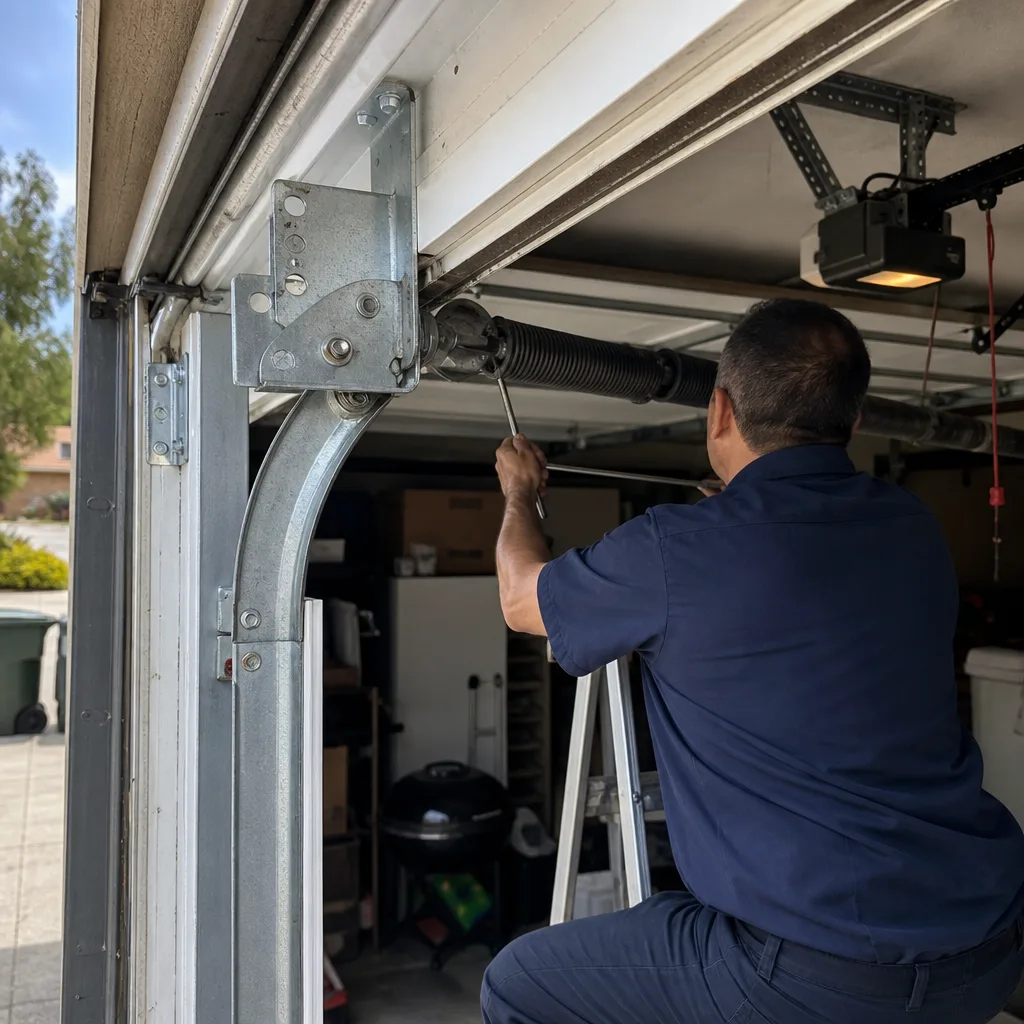 Before
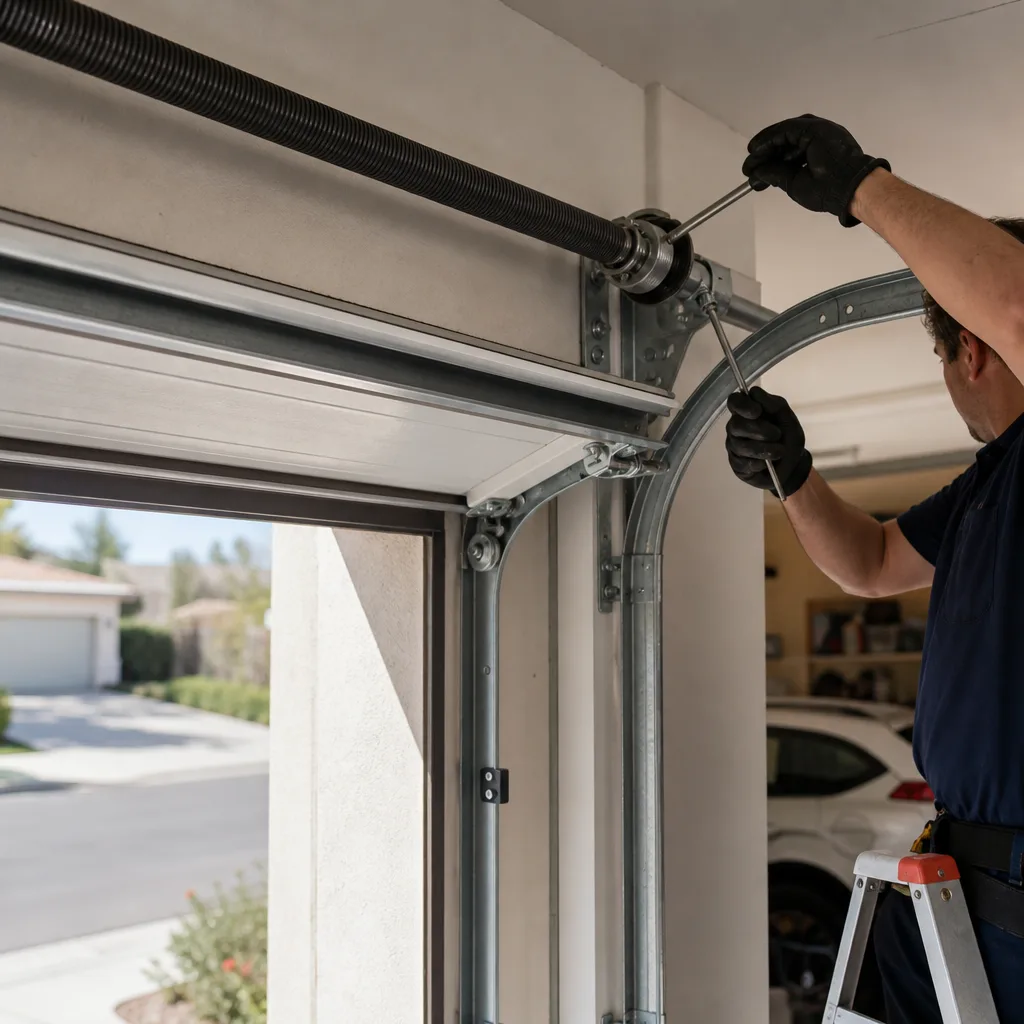 After
After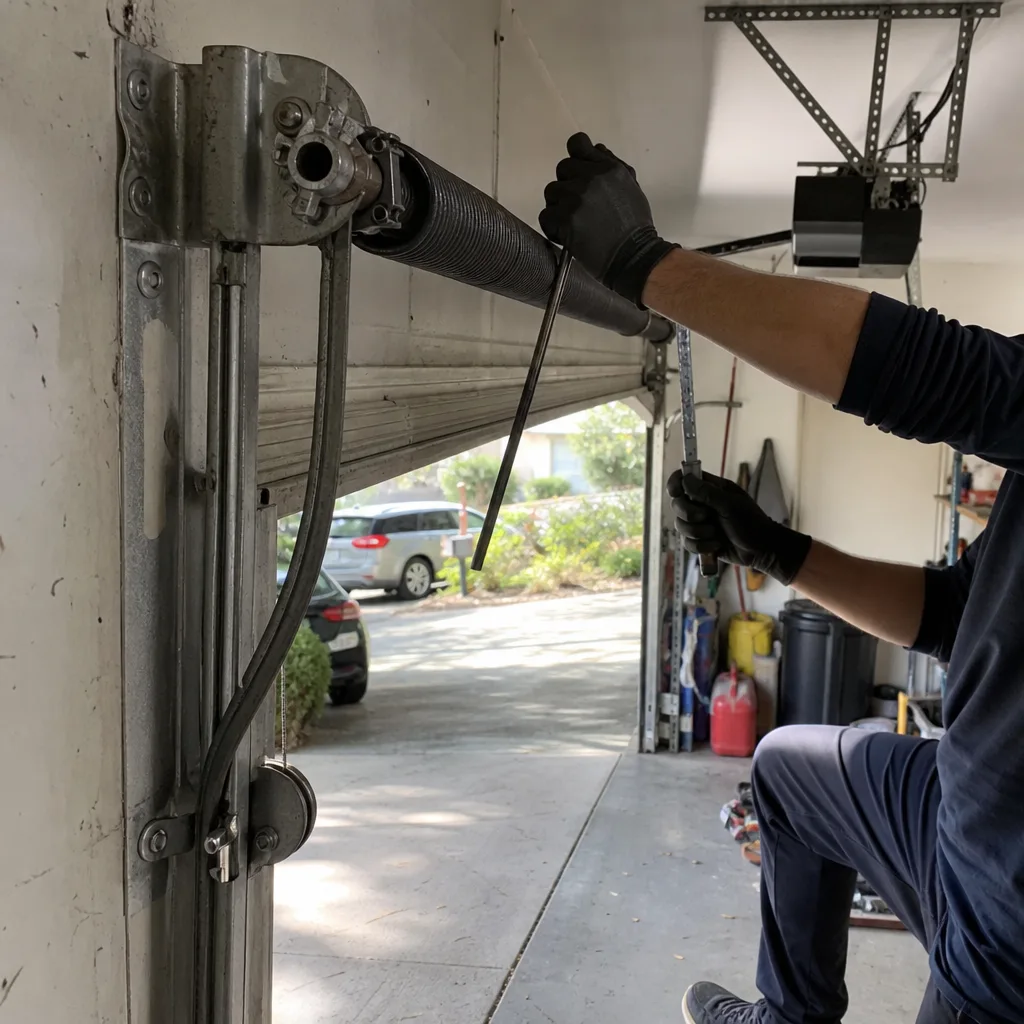 Before
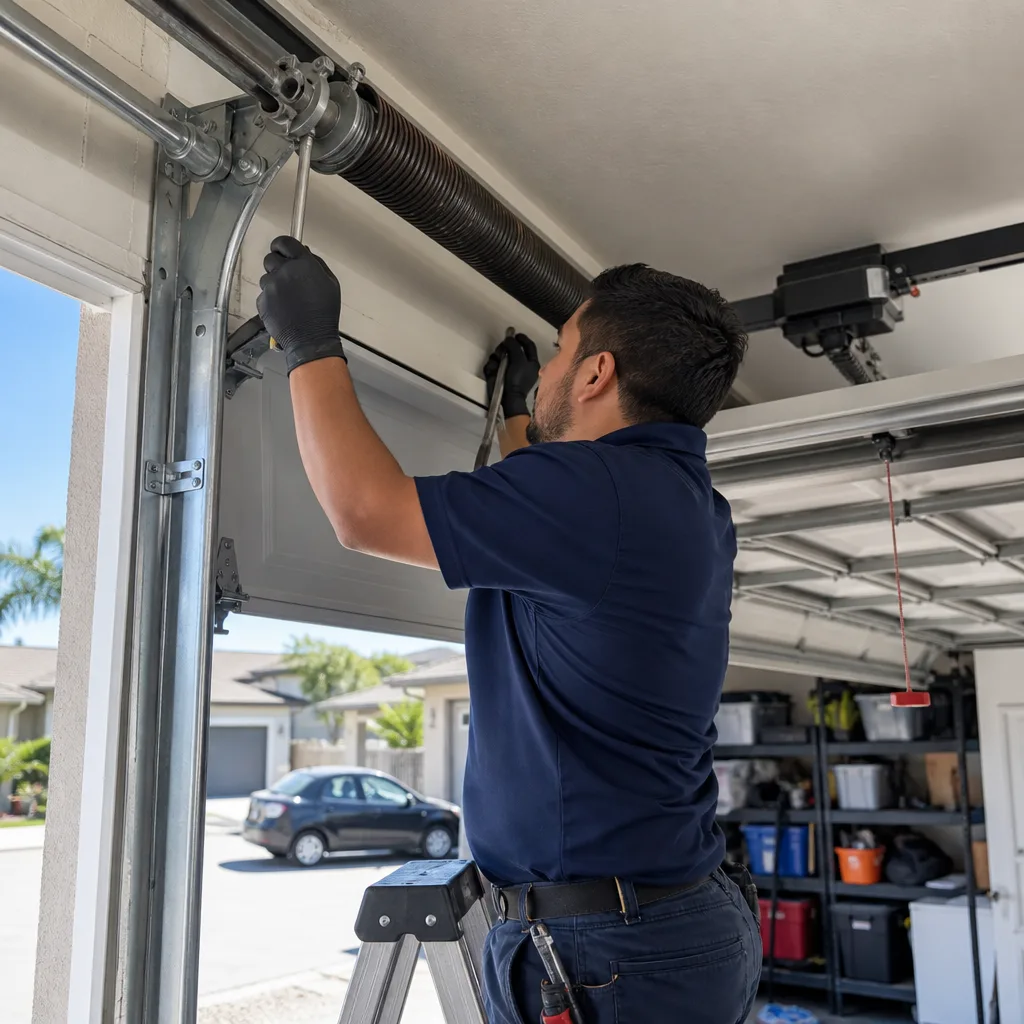 After
AfterGarage Door Warning Signs: A Escondido Homeowner’s Reference Guide
Here’s a number that should get your attention: a garage door weighs between 130 and 400 pounds, and every one of those pounds rides on springs engineered to fail. Not “might fail someday.” Engineered to fail. Torsion springs are rated for a specific number of cycles, usually 10,000. Do the math on two open-and-close cycles a day in Escondido and you land at roughly seven years of life. What most homeowners don’t realize is that the spring announces its retirement long before it snaps. A door that hesitates for two seconds before it moves is not “getting old.” It is telling you exactly which component is struggling. This guide-along with our Complete Guide to Garage Door in Escondido-teaches you to read those signals three to six months ahead of a failure, when the fix is still a $40 minor adjustment instead of an emergency call with your car trapped inside the garage.
Quick Answer
The earliest garage door warning signs in Escondido are a door that hesitates before moving, a grinding or popping noise during operation, visible rust or fraying on cables and springs, a door that drifts down or up when manually released, and an opener that runs louder than it did six months ago. Catching these signs early typically costs under $200 to fix. Ignoring them leads to spring failures that shut the door completely, often when your vehicle is inside. If your door makes a loud bang and won’t open, stop using it and call a garage door professional immediately.
Table of Contents
- The Sound-to-Problem Decoder: What Your Door Is Saying
- The 90-Second Driveway Inspection: Visual Wear Without Tools
- The Door Drift Test: What It Reveals About Your Springs
- Why a Louder Opener Is Almost Never an Opener Problem
- Two Signs That Mean Stop Using the Door Today
- How Escondido’s Climate Accelerates Garage Door Wear
- Repair or Replace: The Honest Math for Escondido Homeowners
- Common Mistakes to Avoid
- When to Call a Professional
- Frequently Asked Questions
- The Bottom Line
The Sound-to-Problem Decoder: What Your Door Is Saying
Your garage door speaks to you every time it opens and closes. Most people hear “noise” and chalk it up to age. A trained ear hears a diagnosis. Every sound points to a different component, and once you know the decoder, you can name the problem before the technician walks through the gate. When we roll up to a home in southwest Escondido, we usually know what we’re dealing with before the homeowner finishes describing it. The sound tells us.
Grinding noise, especially when the door moves through the curve of the track
Grinding is metal-on-metal contact where there should be a smooth rolling surface. Nine times out of ten, it’s the rollers. The bearings inside the roller seize up, the wheel stops spinning, and the roller starts sliding flat against the track, grinding away material. Escondido’s dry, dusty air accelerates this because fine grit works its way into unsealed bearings. Left alone, a seized roller destroys the track it rides on, and that turns a $25 roller replacement into a $200 track section replacement.
Popping sound from above the door when it starts to move
That popping is the torsion spring binding and releasing on the shaft. It’s the spring telling you it’s near the end of its cycle count. The coils are no longer spacing evenly, and as they bind, they pop. We hear this in Escondido homes most often on doors installed between 2010 and 2016, right at the age when original springs hit their cycle limit. When a homeowner reports a popping sound, we tell them to count on a spring replacement in the next 60 to 90 days. It’s not urgent yet. It will be.
Scraping along the edge of the door
Scraping means the door is no longer centered in its track. Something shifted: a cable has stretched unevenly, a track has been knocked out of alignment, or the door itself has sagged. The door is literally dragging its edge against the metal rail every cycle. Every thirty seconds of scraping is shaving metal off the track and wearing the door’s edge. If you see silver dust at the base of the track, that’s not normal wear. That’s your door filing itself down.
A rhythmic squeak that matches the door’s speed
A squeak that pulses as the door moves, like a slow metronome, points to the cable drums. These drums wind and unwind the cables as the door cycles. When the drum bearings dry out, they squeak in a steady rhythm. It’s one of the least dangerous sounds on this list, but ignoring it lets the drum bind, which causes unequal cable tension, which leads to a door that goes up crooked. A crooked door puts side load on the rollers, which accelerates wear across every component.
The sound most people ignore: a soft hiss or creak at the very start of movement
That first-creak is often the spring coils shifting as the door starts moving. It’s the equivalent of your knees creaking on the stairs. It means the spring is working harder than it was designed to, usually because it’s under-lubricated or because one of the two springs has already failed and the other is now pulling double duty. In Escondido, where summer temperatures hit triple digits and the garage becomes an oven, spring metal expands and contracts daily. That thermal cycling weakens springs faster than the manufacturer’s cycle rating suggests, and the first sign is a creak at startup.
If you want to learn more about the mechanical side of your door, we’ve written a full guide on Garage Door Repair in Escondido that walks through how each component fails and what repair looks like.
The 90-Second Driveway Inspection: Visual Wear Without Tools
Most homeowners don’t own a winding bar, and they shouldn’t. But you can identify 80% of approaching garage door failures without touching a single component, standing in your driveway, using only your eyes. Here’s the exact inspection we recommend every Escondido homeowner do four times a year, at the change of each season-see our Seasonal Garage Door Care for Escondido: Year-Round Homeowner’s Guide for the full routine.
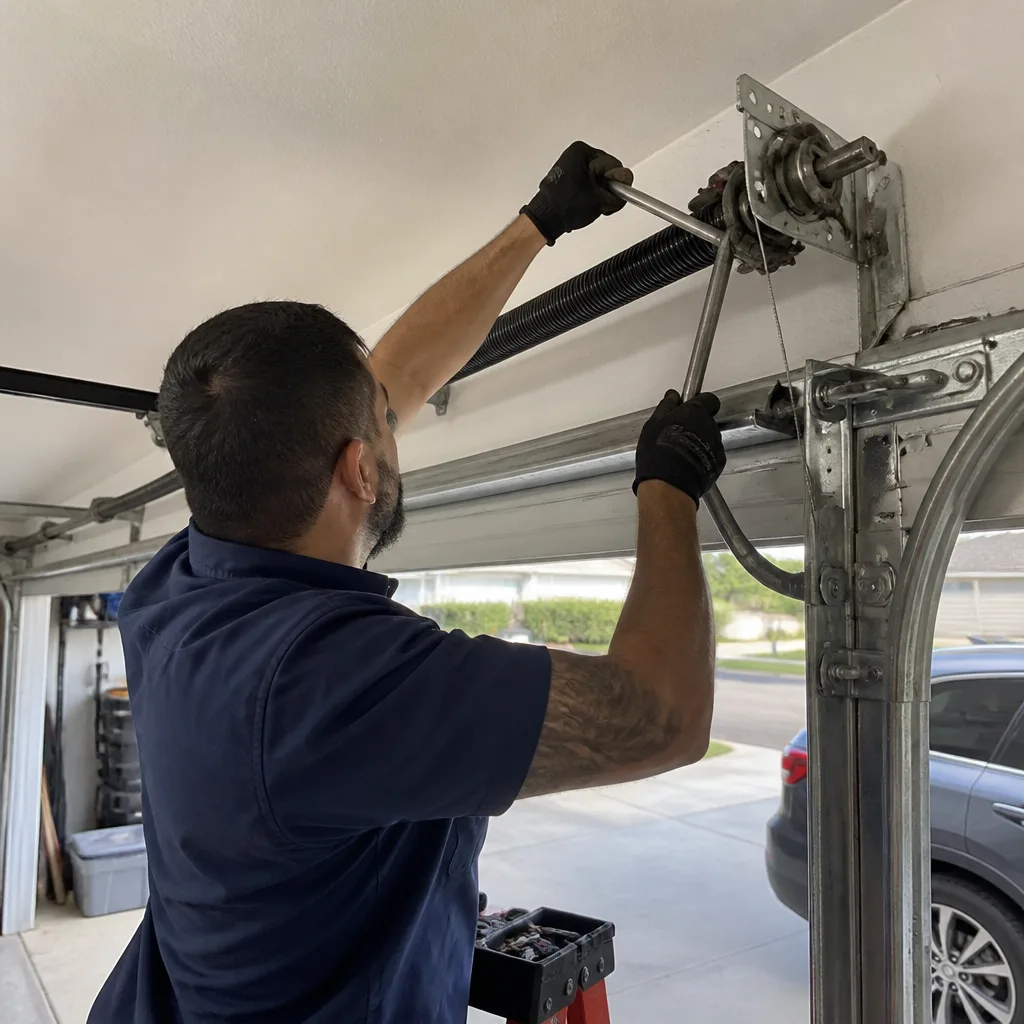
Step 1: Look at the torsion springs (the big coiled springs above the closed door)
Run your eyes along the length of each spring. On a healthy spring, the coils are evenly spaced with a tiny gap between each one. If you see a wider gap at one point, or coils touching in one section and separated in another, that spring is failing. Rust on a spring is also a warning sign. Escondido’s coastal influence means morning marine layer moisture settles on exposed garage components, and rust follows. A rusted spring is more likely to snap because the corrosion weakens the metal precisely at the point of highest stress.
Step 2: Examine the lift cables (the steel cables running along both sides of the door)
Cables should be taut and smooth, with no visible frays. Run two fingers lightly along each cable and feel for any burrs or loose strands. If you see a cable with a few strands pulled away from the main bundle, that cable is on borrowed time. When a cable parts, the door drops on one corner, and the entire door can bind in the track. It’s one of the most dangerous failures because it happens without warning and can dump 300 pounds of door weight sideways.
Step 3: Check the roller stems and hinges for rust-colored dust
Look at the bottom of each track. If you see a fine powder that looks like cinnamon, that’s metal dust from a bearing or hinge wearing away. The source is almost always a seized roller or a hinge pin that has gone dry. The fix is a simple roller replacement or hinge lubrication. The cost of ignoring it is a scored track.
Step 4: Sight down the length of the track from the front
Stand at the front of the garage and line your eye up with the vertical track on one side. The track should be a perfectly straight line from top to bottom. Any bow, bend, or visible gap between the track and the wall means the track has been knocked out of alignment. In Escondido, this happens most often when a car bumper taps the track in a tight garage. It’s common in older neighborhoods like the homes built off Valley Parkway in the 1970s, where garages are narrow and door tracks sit tight to the walls.
Step 5: Watch the door as it opens fully
Your eyes should track the top section of the door as it travels up and back. The door should move smoothly with no hesitation, no rocking side to side, and no visible gap opening up between the sections. If the door shudders as it starts, or if one side lifts before the other, that’s a spring imbalance.
The Door Drift Test: What It Reveals About Your Springs
This test tells you more about your garage door’s health than any single observation, and it takes forty-five seconds with the door closed and your car out of the way. It requires releasing the door from the opener, but do not disconnect the door while it’s raised: always run this test with the door closed, on the ground.
How to run the drift test safely
- Pull the red emergency release handle hanging from the opener rail. This disconnects the door from the opener carriage.
- Grab the door handle and lift it manually until it’s about waist height.
- Let go of the door completely.
Reading the results
- Door stays exactly where you left it: Your springs are balanced. The spring tension is matched to the door weight, and the door is doing what it was engineered to do.
- Door drifts down slowly: Your springs are losing tension. The spring counterweight is no longer holding the door’s full weight. Within a few months, the door will get heavy, the opener will start straining, and you’ll be on the path to a spring failure.
- Door drifts upward: This is less common but more urgent. It means the springs are over-tensioned, which puts excessive load on the cables and the drums. An over-tensioned spring can snap violently or spin the shaft.
- Door falls fast or is hard to lift at all: One of your springs has already failed, or has lost so much tension that the remaining spring cannot carry the load. This is the two-sign warning covered below: stop using the door and call today.
We get calls from Escondido homeowners all the time who ran this test after reading about it and discovered their door drifted down a foot in five seconds. That’s not a worn door. That’s a failed spring hiding in plain sight, and the door has been running on one spring for weeks. If you’d rather have someone else run the test and show you the results, give us a ring at (760) 313-7785 and we’ll do it together during a service visit.
Why a Louder Opener Is Almost Never an Opener Problem
Here’s a belief we correct at least once a week in Escondido: if the opener sounds louder than it used to, the opener is failing. That is almost always wrong. The opener is a small electric motor that pulls a chain or a belt. It has one job: move the trolley along the rail. When the door gets harder to move, the opener has to work harder to move it, and the motor makes more noise. The noise is not the motor failing. The noise is the motor telling you the door is getting heavy.
What a louder opener actually signals
- Dying springs: As springs lose tension, the opener carries more of the door’s weight. The extra load makes the opener emit a deeper, more strained hum. The opener is not the problem. The springs are, and replacing the opener without replacing the springs just gives you an expensive new motor that has to work just as hard.
- Seized or failing rollers: Rollers that no longer spin freely add friction to every cycle. The opener overcomes that friction, and the motor works harder. You’ll hear more grinding and the opener will sound like it’s pushing through something, because it is.
- Worn gears inside the opener: This is the one case where the opener really is the problem. Opener gears are plastic, and on openers older than ten years, the gear teeth can strip. The opener will make a rattling, chattering noise and may slip. But even here, the root cause is often the door weight: stripped gears usually follow years of pulling a door with weak springs.
Before you replace an opener in Escondido, have the mechanical side checked. We respond to calls where the homeowner has already bought a new opener from a big-box store, and the problem turns out to be a $180 spring replacement. The right fix for the wrong diagnosis is still the wrong fix. If you’re weighing opener replacement, our guide to Garage Door Opener in Escondido covers when replacement makes sense and when repair does.
Two Signs That Mean Stop Using the Door Today
Every warning sign in this guide falls into one of two buckets: signs you can address in the next few weeks, and signs that demand immediate action. These two are the second bucket. If you experience either one, do not run the door again. Call a professional and leave the door as it is, even if that means your car stays inside the garage tonight.
Sign 1: A loud bang and the door refuses to move
That bang is a torsion spring snapping. One of the two springs above your door has broken, and the remaining spring is now holding the entire weight of the door by itself. It may keep working for a few cycles, but every cycle overloads the remaining spring and increases the odds of a second snap. If the door is open when the spring snaps, do not try to pull it closed manually. A door with a broken spring can fall fast, with hundreds of pounds behind it. This is not a DIY job. The springs are under extreme tension, and the tools used to wind them require training. We’ve responded to emergency calls in Escondido where a homeowner attempted a spring replacement with improvised tools, and the result was a trip to urgent care. Do not be that person.
Sign 2: The door jerks to one side while moving, or one cable is visibly loose
If the door is moving and you see it lurch toward one side, or if one of the two cables has slack while the other is taut, a component has already failed. This is almost always a broken cable or a shattered cable drum. Continuing to run the door risks jamming it in the track, bending the track, and creating a situation where the door becomes stuck halfway and cannot be moved safely. This also is not a DIY repair. Cables are tensioned against the same springs that make the boom, and you do not want your hands near them when they’re loaded.
The good news: both of these are exactly the kind of call we handle every week in Escondido. A live person answers the phone at (760) 313-7785 day or night. We quote the repair on the call, hold that price at the door, and get you back to a working garage fast.
How Escondido’s Climate Accelerates Garage Door Wear
Escondido sits in a climate pocket that is uniquely rough on garage doors, and most national advice ignores it completely. We’re inland enough to bake in summer, close enough to the coast that morning marine layer reaches us in spring, and dry enough year-round that the dust never really settles. Each of those elements works against your door in different ways.
Summer heat and spring metal
Escondido regularly hits 95 degrees or hotter in July and August. Your garage becomes a convection oven, and the air temperature inside a closed garage can exceed 120 degrees. Torsion springs are steel, and steel expands when it heats. The spring expands along its length, changing the coil spacing and the tension profile. When the evening cools things down, the spring contracts. Over a season, that daily cycle of expansion and contraction weakens the spring’s metal, and the spring fails earlier than the manufacturer’s cycle rating would predict. This is a documented failure mode, and it’s one reason we replace springs in Escondido more frequently in fall, after the summer heat has done its cumulative damage.
Marine layer moisture and rust
Spring mornings in Escondido bring a damp marine layer that burns off by mid-morning. The problem: that moisture has already settled on your door components. Then the afternoon heat dries it, leaving behind a micro-layer of salt and mineral deposits. Rust on cables, springs, and track hardware is the long-term result. A rusted cable is a weakening cable, and a rusted spring snap is more dangerous than a clean break because the failure point is unpredictable.
Dry dust and unsealed bearings
Escondido is dry country, and that dry soil becomes airborne dust. That dust finds its way into every unsealed bearing on your door: rollers, hinges, cable drums. The dust isn’t abrasive enough to destroy a bearing quickly, but it mixes with the existing grease and forms a paste that thickens over time. Eventually, the bearing binds. The seal drags. The roller stops spinning. And the sound your door starts making is exactly the grinding noise from the decoder section.
All of these climate factors are why we recommend four driveway inspections a year, not the annual check most national guides suggest. Escondido conditions simply work faster.
Repair or Replace: The Honest Math for Escondido Homeowners
When warning signs appear, the question becomes: repair the failing part, or replace the whole door? The honest answer varies by the age of your door and the condition of the other components. Here’s the practical math we walk Escondido homeowners through.
When repair is the clear answer
- Spring replacement on a door under 10 years old: Springs are a wear item, like brake pads. If your door is in good cosmetic condition and the panels are straight, replacing the springs extends the life of the door by years. Expect to pay between $180 and $340 for a two-spring replacement in Escondido, depending on the door size and spring type.
- Roller replacement: A full set of rollers runs $90 to $160 installed. If the door’s other components are sound, there’s no reason to replace the door over rollers.
- Cable replacement: A cable replacement is usually a $100 to $180 job. The key is catching it before the cable snaps and causes secondary damage.
- Track realignment: When a track gets knocked out of line, the fix is usually an hour of labor and some hardware. You don’t replace the door because a track shifted.
When replacement deserves honest consideration
- The door is 15+ years old and multiple components are failing: If you’ve replaced springs once and the rollers are going and the bottom weather seal is dry-rotted and the panels are starting to delaminate, the next five years of repairs may approach the cost of a new door. A good mid-range door in Escondido, installed, runs between $1,200 and $2,400 depending on size and material, and it buys you twenty years of use.
- The door has structural damage: A bent section, a cracked panel from a car impact, or rusted-through stiles are not repairable in any cost-effective way. Patch jobs on structural damage fail, and you end up replacing the door anyway.
- You want integrated features: If you’re planning to upgrade to a smart opener, a quieter door, or better insulation, sometimes replacement makes more sense than retrofitting an older door.
We’ve done the math with hundreds of Escondido homeowners, and the answer is rarely obvious from the outside. If you’re in the gray zone, a free estimate is the fastest way to get an honest recommendation. You can also read our guide to Garage Door Installation in Escondido if you want a deeper look at what replacement costs and what the options are.
Common Mistakes to Avoid
- Lubricating to cover up a noise: Spraying a squeak with WD-40 masks the symptom without fixing the cause. WD-40 is not a lubricant for garage door parts; it’s a solvent that strips existing grease. If the noise persists after proper lubrication, you have a mechanical problem.
- Replacing the opener before checking the springs: We covered this above, but it’s the most expensive mistake homeowners make. A $500 opener does not fix a $200 spring problem.
- Running the door on one spring after a snap: The remaining spring can hold the door for a while, which tempts homeowners to keep using the door. Every cycle overloads that spring and risks a second snap, this time possibly with the door in the open position.
- Ignoring a drifty door because it still goes up and down: The door still opens, so it must be fine. That’s how a spring replacement in April becomes an emergency service call in August, sometimes with a damaged panel from an uncontrolled drop.
- Doing your own spring work after watching a video: Torsion springs store enough energy to remove fingers or break bones. We say this not to scare you, but because we’ve seen the aftermath. A door is 200 pounds riding on two springs. Respect it. Call someone who winds springs professionally.
- Skipping the weather seal because the garage “doesn’t leak”: In Escondido’s summer heat, a failed bottom seal is the difference between a garage that reaches 110 degrees and one that hits 130. The seal also keeps dust and pests out. It’s a $40 fix.
When to Call a Professional
Some things on your garage door are genuinely safe to handle yourself: tightening a loose hinge bolt, cleaning the track, replacing a weather seal. Other things require a trained hand and a winding bar. The line is simple: anything connected to the springs or cables is professional territory. If you’ve spotted a popping spring, a frayed cable, a door that drifts badly, or either of the two stop-immediately signs, call someone-our How to Hire a Garage Door Contractor in Escondido: A Step-by-Step Guide can help you know what to look for. Otto’s Garage Door offers free estimates in Escondido, and every repair is quoted before we start, with the price agreed at the door and never revised upward. Call (760) 313-7785 and the person who answers is the person who shows up, usually Otto himself.
Frequently Asked Questions
A two-spring replacement in Escondido typically costs between $180 and $340, depending on the door’s size and the spring’s rating. Single-spring doors, common on older single-car garages, run slightly less. The price includes the springs, installation, and in our case, a 90-day written promise on the work. Call (760) 313-7785 for an exact quote based on your door.
Yes. We carry the common parts on the truck: springs, rollers, cables, hinges, and opener parts. Most warning-sign repairs are completed in a single visit, often within an hour of arrival. For emergency spring or cable failures, we respond day or night, and a live person answers the phone around the clock.
No. We quote the repair on the phone based on what you describe, and we hold that number when we arrive unless the situation is materially different from what was described, in which case we show you the difference and get your approval before doing any work. The price you agree to is the price you pay, with the 90-Day Done Right Promise written on the invoice.
Four times a year, at the change of each season. Escondido’s heat, marine layer moisture, and dry dust combine to accelerate component wear, and a quarterly driveway inspection catches problems one to two seasons before they become failures.
We repair and install all major brands, including LiftMaster, Chamberlain, Genie, Clopay, Amarr, Wayne Dalton, Craftsman, and Raynor. If your door has a brand name on it, we’ve probably worked on one this week.
Some things, yes: lubricating hinges, tightening bolts, replacing a weather seal. But anything involving springs or cables requires training and specialized tools. A torsion spring under tension has enough stored energy to cause serious injury. If you’re unsure, call us and we’ll tell you over the phone whether it’s a safe DIY fix or a job for a professional.
The Bottom Line
Your garage door tells you what’s wrong long before it fails. The grinding, popping, scraping, and creaking are not random noise. Each sound is a specific component announcing wear, and the 90-second driveway inspection catches visual signs that confirm what the sounds suggest. Run the drift test quarterly, watch for rust on cables and springs, and respect the two signs that mean stop using the door immediately. Caught early, most garage door problems in Escondido are fixed for under $200 and an hour of time. Ignored, they become emergency repairs with your car trapped and your schedule wrecked. The name on the van is the name on the invoice and the name on the license. Call (760) 313-7785 for a free estimate, and we’ll help you read what your door is saying. For more guides & resources, visit our blog.
Written by Otto Reinhardt, Owner at Otto’s Garage Door, serving Escondido since 2004.